
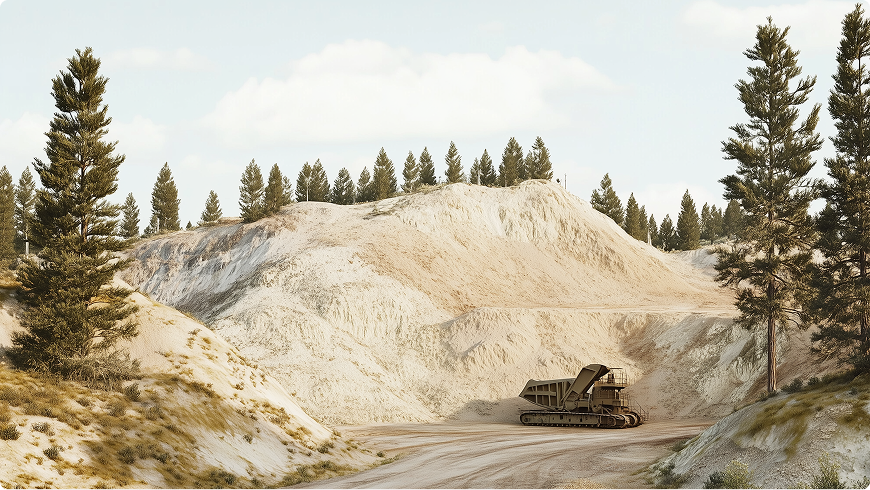
Sand is a poet’s favorite metaphor for time, abundance, and the quiet power of tiny things moving together. We love that poetry. But at eSand, we also bring a scientist’s lens to it—because precision is the language of trust. So we set ourselves a playful challenge with a serious point:
How much is a single grain of sand worth—and how precisely can we prove it?
Spoiler: it’s “almost nothing” … and the way we get there shows everything about how we measure, model, and verify in the eSand ecosystem.
The short story you can tell your friends
- Humanity uses ~50 billion tons of sand every year.
- Not all sand is equal. Value depends on quartz (SiO₂) content, grain size, shape, distribution, and extraction complexity.
- Assume a straightforward example: quartz sand > 80% SiO₂, grains modeled as spheres, and sizes following a bell curve (16% fine, 68% medium, 16% coarse).
- Price per metric ton (1,000,000 g) in this example: $30.
- Using density 2.65 g/cm³ and volume V = 4/3 · π · r³, we can compute grains per ton by size.
- Then we blend them (16–68–16 by mass) and divide $30 by the total grain count.
- Result: the price of a single grain is 0.000000000251578041 USD.
(Yes, we went to 18 decimals. Yes, we had fun.)
The bell curve, at a glance (16–68–16)
Conceptual illustration of a normal distribution. In our example, ~16% of the mass is fine grains, ~68% is medium, ~16% is coarse. Small grains are numerous, large grains are few—physics takes care of the rest.
(Chart below)
The numbers (clean and simple)
Per‑grain physics (if 1 ton were 100% that size)
Grain class |
Diameter (mm) |
Volume per grain (cm³) |
Mass per grain (g) |
Grains per 1 ton |
Fine |
0.10 |
0.000000524 |
0.000001388 |
720,701,629,095 |
Medium |
0.50 |
0.000065450 |
0.000173442 |
5,765,613,033 |
Coarse |
2.00 |
0.004188790 |
0.011100294 |
90,087,704 |
Note:
The coarse count is ~90.1 million per ton (not billion).
Bigger grains = heavier per grain = fewer per ton.
16–68–16 blend (by mass) — how many grains per ton, in total?
Grain class |
Mass share |
Grains contributed |
Share of total count |
Fine |
16% |
115,312,260,655 |
96.70% |
Medium |
68% |
3,920,616,862 |
3.29% |
Coarse |
16% |
14,414,033 |
0.012% |
Weighted total grains per ton: 119,247,291,550
Price per grain (at $30/ton):
0.000000000251578041 USD
Why obsess over decimals?
Because luxury begins with clarity. The eSand standard is no ambiguity between the token and the ton. When we say an asset exists, we mean: it’s identified, measured, reconciled, and independently evidenced—again and again. Counting grains isn’t just cute; it’s a window into how we engineer trust:
- From first principles: physics, not marketing.
- Blended reality: distributions, not guesses.
- Transparency: numbers you can follow, logic you can check.
And the punchline is delightfully counterintuitive: in our blend, fine grains are only 16% of the mass but ~96.7% of the count. Small things add up—literally.
A tiny joke with a very real point
At 0.000000000251578041 USD per grain in this scenario, you’d need a lot of grains to buy a coffee. ☕️ But you don’t need a lot of trust to verify the math—because we show our work.
What this says about eSand
eSand is built for people who appreciate the quiet rigor behind beautiful things:
- Substance: identified, high‑purity quartz reserves.
- Rights: clear, enforceable holder claims.
- Records: independent verification on a regular cadence.
That’s why we go to 18 decimals without blinking. Precision isn’t an aesthetic—it’s a promise.
One last smile before you go
Because we’re serious and playful about precision: in the eSand ecosystem, we can even sell you half a grain of sand. You own it. And if you ever want to feel the poetry in your palm, come to our mine and redeem your single grain.
We’ll be ready—with tweezers.